Showing posts with label Poetry. Show all posts

Monday, December 09, 2019

Virtual Advent Tour 2019: Winter Evenings

Virtual Advent Tour is hosted by Sprite at Sprite Writes.

A picture of 4 wooden statues of two adults and two children on a glade by the river dancing while holding hands

There is something magical about winter evenings when you are warm and comfy while it is freezing and windy outside. With the fire going and a hot beverage, it is nice to just be in comfortable silence and perhaps enjoy a good piece of poetry.

One such piece is a poem that hit me straight in the heart when I first heard it many years ago, a romantically melancholic, just like a Slavic soul likes best, and I had that instant 'a-ha' feeling of relating to it, for back then I did literally live in an old house in the middle of the marshes and cold, wild wind knocking on our shabby windows was a familiar visitor during many a winter evening while sitting by the wood stove with my grandmother.

I know it by heart in Slovene translation and it takes me straight back to my childhood whenever I remember it. Incidentally, its title is Winter Evening and it remains one of my favourite pieces of poetry. I am pasting it below with some imagery that reminds me of the 'olden' days. ;)

Winter Evening
by A. S. Pushkin


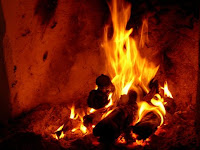
A brightly burning fire in a fireplaceO'er the earth a storm is prowling, Bringing whirling, blinding snow.
Like a beast I hear it howling,
Like an infant wailing low.
Now the thatch it rustles, playing
On our roof; now at our pane
Raps like someone homeward straying
And behighted in the plain.


Old our hut is, dark and dreary,

By a candle dimly lit...
Why so sad, my dear, and weary
At the window do you sit?
Is't because the storm is moaning
That so very still you keep?
Does your spindle's mournful droning
Put you quietly to sleep?

An isolated cottage in a snowy landscape at night with full moon shining
Come, O comrade solitery
Of this cheerless youth of mine,
Take a cup, and let us bury
All our many woes in wine!
Of a maid out by a river
Sing a little song to me
Or a tomtit, one that never
Leaves its home beyond the sea.


O'er the earth a storm is prowling,

Bringing whirling, blinding snow.
Like a beast I hear it howling,
Like an infant wailing low.
Come, O comrade solitery
Of this cheerless youth of mine,
Take a cup, and let us bury
All our many woes in wine!

(Translated by I. Zheleznova.)

Do you have a favourite piece of poetry that reminds you of winter and/or childhood? 

Friday, June 20, 2014

The Fall of Arthur by J. R. R. Tolkien

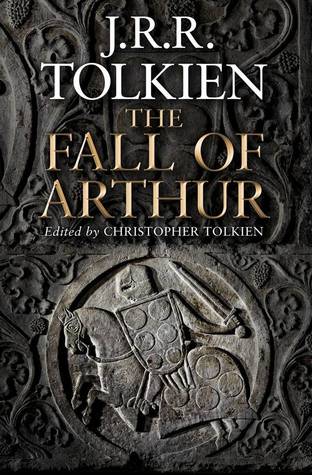
The Fall of ArthurSUMMARY (from Goodreads): The Fall of Arthur recounts in verse the last campaign of King Arthur who, even as he stands at the threshold of Mirkwood, is summoned back to Britain by news of the treachery of Mordred. Already weakened in spirit by Guinevere's infidelity with the now-exiled Lancelot, Arthur must rouse his knights to battle one last time against Mordred's rebels and foreign mercenaries.

Powerful, passionate and filled with vivid imagery, The Fall of Arthurreveals Tolkien's gift for storytelling at its brilliant best. Originally composed by J.R.R. Tolkien in the 1930s, this work was set aside for The Hobbit and lay untouched for 80 years.

Now it has been edited for publication by Tolkien's son, Christopher, who contributes three illuminating essays that explore the literary world of King Arthur, reveal the deeper meaning of the verses and the painstaking work that his father applied to bring it to a finished form, and the intriguing links between The Fall of Arthur and his greatest creation, Middle-earth.

MY OPINION:

Anyone expecting The Fall of Arthur to be an epic story dealing with Arthurian legends, would be disappointed, as The Fall of Arthur is only Tolkien’s unfinished attempt at his own retelling of the legend of King Arthur.

Tolkien’s poem, written in a form that more or less resembles the Old English alliterative verse, is only about 40 pages long. The rest belongs to Christopher Tolkien’s explanation of his father’s possible sources for the poem as well as his writing process and finally an excerpt from Tolkien's lecture on alliterative verse.

The poem itself, though beautifully crafted, is a clear evidence of Tolkien’s dwindling interest in it, or perhaps running out of time for finishing and editing it, as the beginning is clearly better done, especially in terms of the rules of alliterative verse, than the end. Yet, even in such an unfinished state, the poem is still another proof of Tolkien’s genius.

The rest of the book, with speculations on sourcing and development of the poem, may be of no interest to people only looking for a story, or may seem boring, as its value is above all meta-linguistic and meta-literary. However, to me – from a writer’s point of view – it was not only interesting, but also inspiring to see a glimpse of Tolkien’s writing process and his approach to it, both concerning this particular work as writing in general.

Hence, The Fall of Arthur was a fascinating read, and I enjoyed it very much.

4 stars
RECOMMENDATION:
The Fall of Arthur is largely a non-fictional, analytical read, and as such quite demanding but intriguing. However, it might be a disappointment if you just want a good story.