Showing posts with label * NOT STRANGE. Show all posts

Saturday, October 06, 2018

Someone Else’s Fairytale (Someone Else’s Fairytale #1) by E. M. Tippetts

The concept of Someone Else’s Fairytale – a movie star falling for the one girl whose dream isn’t a hot movie star falling for her – was intriguing, but that was also all.

However, it kept me reading through to the end, which earns it half a star more than it would have for the plot and the characters. Because this was one of the dumbest stories I have ever read. And there were so many annoying things.

Of course the male BFF is actually pining for the main character in a romantic way. Or is she pining for him? I don’t know. Because clearly men and women can’t be ‘just’ friends. Right.

The said BFF also presumes to tell the protagonist who she shouldn’t be friends with and how often she should talk to them. Red flags rising my hackles all around.

Then, Chloe, from whose POV the story is written, sounds awfully immature, despite being through quite an ordeal in childhood and apparently having to take care of herself. She is 21, but her actions and even more her reasoning are those of a 15-year-old. As someone who basically had to grow up at 14, I couldn’t at all relate to her childishness – and it shows the author clearly wrote neither from experience nor from sufficient research.

But most of all, the story is just bland, as in, there isn’t any story – only enumeration of this and that which happens, and the reader knows the main characters will get a HEA anyway. There is some drama due to Chloe’s past, but it doesn’t really serve the story, although it is rather interesting on its own, and I think the author would have had more success with it if she had written a YA thriller about that ordeal instead of this ‘romance’.

The characters are equally bland. There are hardly any descriptions (and I don’t mean hair/eye colour, height and whatnot; there aren’t even any mannerisms and such that make up a person(ality)), unless you count  unfavourable ones of the supposedly hot movie star. And while leaving physical appearances up to the reader’s imagination can work out marvellously, this isn’t the case in Someone Else’s Fairytale. Hence, everyone seemed just words on paper, dead, and I felt no connection to any of them.

Which brings me to the last and worst: the story was feeling-less. It is supposed to be a romance, but I couldn’t feel a thing reading it. Angst? Love? (Who am I kidding?) Tension? Happiness? Sadness? Anything? Nope, nothing. A phone book makes me feel more.

At least it was free on Kindle.

Saturday, September 02, 2017

The Cold King by Amber Jaeger

Note: This review contains SPOILERS.

At first, this was so bad that it was sort of entertaining.

We have a Cinderella-meets-the-Beauty-and the-Beast-with-a-hint-of-the-Phantom-of-the-Opera-like story that reads like terrible BDSM, just without sex (which actually makes it worse), but with a generous dash of brainwashing.

The male protagonist (aka the villain, I am certainly not calling him a hero) is a sadistic and manipulative asshole, who throws the female protagonist in a dungeon to make the transition from her old life to the new one ‘easier’ – for him, of course. After all, it is much easier to brainwash someone to accept common human decency and having one’s basic needs met as luxury if one has only ever been shown cruelty – though, as they say, the absence of cruelty is not the same as kindness – than win them over by treating them right from the beginning.  

The cold king is a typical abuser, targeting the weak and isolated and tearing them down before building them back up to his own desires by making them completely dependent on him, all of which he justifies as improving their lives and showering them in luxury they could never experience otherwise.

Even Calia recognises that as shitty but falls for it hook, line, and sinker, as does everyone else – who, by the way, does nothing to help her at least with good advice. But, after all, that is neither Calia’s nor the others’ fault, since they are all victims and Calia with her reasoning the most typical of them all.

The cold king is supposed to be a tortured hero, but even if his pain is understandable, it doesn’t excuse his behaviour. I couldn’t feel even remotely sorry for him or his predicament for being cursed (with the curse of his own doing.) He also has a giant ego, and naturally, as people of his kind do, knows better what is best for Calia and others then they do themselves.

Calia herself is an ‘extreme Cinderella’, ignored and disliked by everyone, including her horrible, abusive, and neglectful mother. Her poor fortune and suffering (in comparison to everything else, all her crying was the least of a bother) is exaggerated to the maximum in order to garner sympathy. Needless to say, it didn’t work for me.

She is also quite a bit of a Mary Sue, suddenly becoming pretty (no, hair growth does not work like that!), graceful, and smart (she learns to read very fast, knows things she had nowhere to learn (such as doing cuff-links), passes sound judgements, etc.), except, of course, for her own situation.

All of the above perpetuates the terrible message that if a woman suffers quietly through abuse, accepts her lot in life, and moulds herself completely to the abuser’s wishers, she will get her fairy-tale ending.

Because, of course, in the end the male protagonist falls in love with her (which also undoes the curse, duh!) and learns the error of his ways and changes for the better and treats her like a queen (literally) – which doesn’t happen in real life.

Calia only develops a bit of a spine towards the end, but only because she is hurting by her love not being requited, and not, you know, because of all other terrible things the cold king has done to her.

The book only gets worse after the half-way mark when we suddenly get multiple, jumping POVs, including the omniscient POV (either that or Calia becomes telephathic), and every ridiculous romance (but not romantic) cliché in existence is used and abused for the contrived quasi-love story.

With putting Calia in the role of a personal servant – who basically does what a valet would – and other characters’ occupations, Jaeger tried to subvert gender roles, which would be commendable, but fell flat due to the characterization which was unflattering in Calia’s case and virtually non-existent in other characters who were mostly bland and one-dimensional.

Add to this an attempt of ‘progressiveness’ by having the cold king be accepting of a same-sex couple, except that it was poorly executed, since kindly ‘overlooking’ their ‘friendship’ is not exactly the same as not being homophobic.

I won’t even go into all the inconsistencies within the story. For example, the setting is undecided on whether to be steampunk-ish with some ‘high’ tech, such as a likeness of modern plumbing and the use of diamonds for industry and craft, or one of a pre-industrial impoverished agricultural society.

Perhaps indecisiveness is at the core of this book’s problems. The blurb says that “… Not every Beast is a prince charming at heart and not every Beauty is a maiden just waiting for love…” and perhaps the author wanted to be edgy and actually re-tell The Beauty and the Beast as a story about abuse, but failed at it, because the end result is something that goes back and forth between trying to be just that (mostly) and a classic HEA fairy-tale but ending up as a horrible mess instead.

Overall, by the end of the book, I wasn’t entertained by the bad-ness of it anymore, only disgusted. 

Wednesday, March 15, 2017

DNF Review: Lords of the City by Alice Ward

Note: The book reviewed contains themes only appropriate for those over the age of 18. Also, take heed that there are some SPOILERS below.

There is a first time for everything, including writing a DNF review, right?

Lords of the City is a bundle of standalone romance novels featuring Chicago billionaires finding their HEA with the women (and the readers, I guess) they bring to their knees with their alpha-maleness and bad boy attitude.

Alas, the stories themselves fall extremely short of this highly misleading description, apart from the first novella. 

This is what I noted down when I finished Lured:
It is a shame this wasn’t a full novel, because Niall and Emma and their relationship totally intrigued me. Unfortunately, as it is only a novella, the story, characterization, and relationship development (or not-development) are rushed and one has to imagine and/or speculate about the depths of their characters and relationship, although there are so many things that should/could be explored more in depth in regard to both characters, but especially Niall, which are only hinted at.                                                                                  
Nevertheless, it is an interesting introduction to the series and I expect the epilogue novella will function as a second part and hopefully deliver a satisfactory (and happy) conclusion to this tragedy. And it is a tragedy, because while Niall behaves like a jerk and he is an idiot, there are certainly reasons for him being as he is and I really need to see him getting to the bottom of his idiocy and his painful (I assume) past and become a better man.                                                                
And while I can give Niall a bit of a benefit of the doubt, I also understand Emma’s hurt and her own conclusions about Niall’s supposed (at least currently) irredeemability.                                                                                                                                  
Overall, it was a bit of a hit-and-miss, because it felt like I could like the story and the characters but I missed that added depth that would make me actually like them. The price of the shortness, I guess.
And that was all that was good about the series.

I read a few chapters of Torn, but I should've guessed that the protagonist describing herself as quirky couldn't mean anything good. I couldn't get into the book, because I didn't feel any connection to the characters.

I found Noah particularly annoying with his wish to remake the female protagonist (I can't even remember her name) into what he wants 'his' woman to be. Fine, if you want to have a dress code for your company and compensate your employees for having to readjust their wardrobe to fit the code. But forcing a woman to limit her style exclusively to 'curve-hugging' dresses with disregard of her own comfort and style is sexist and disrespectful, not romantic and certainly not 'professional' and the book lost me there (especially with the 'quirky' lady happily going along with it.)

I tried the beginning of the second book, but I, again, wasn't drawn neither to the story nor to the characters. So, I decided to quit and not even bother with the third book.

The epilogue novella was a also a disappointment, because instead of continuing Niall and Emma's story, Emma simply disappears and instead of her another woman appears in Niall's life out of the blue and I guess he gets his HEA with Candace (but of course it must be Candace), probably without having to overcome his inner turmoil or, god forbid, change.

Also, despite the description that says that these lords of the city would bring us to our knees during a 'raw, emotional journey', these 'bad, bad boys' and their supposedly 'sexy and delicious' stories were pretty tame and far from 'thrilling' – quite the contrary, to me the series was actually too boring to finish.

There are two parts of another Ward's series included in the bundle but I didn't even bother with those.

I can see why this was on sale: give people a deal price for the bundle and 'lure' them in with the first, otherwise unavailable, novella, just in case at least some people might find any appeal in the rest of the materials included.

Overall, the best part of this was the prologue novella, Lured, even with its tragic ending, which I guess was also worth the price of a bit over an euro, while the rest was a free 'bonus'. 

3 stars for Lured, 0 stars for the rest. 


Wednesday, March 19, 2014

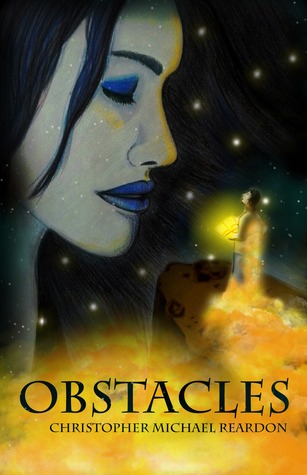
Obstacles by Chris Reardon

SUMMARY (from Goodreads): A child will die. You're afraid to live. Would you go to all lengths to save him? Darkness knows no bounds, as Alcott, an African American doctor sees all too well. The man is petrified by death. His fragile existence rests at the mercy of the universe. This fact is far too much for him to handle. From unyielding nightmares to elevator terrors, he's lost in paranoia.

Assigned to look after an ill child, Alcott's horrors only heighten. Gari is a nine-year-old boy with a fatal disease. He will surely pass on within the year. Alcott bonds with him more and more each day. Part of him knows this grim fate just isn't right.

Alcott befriends a hospital patient. This lunatic forces him to lug home an ancient text on bringing back the dead. Despite the man's obvious dementia, Alcott attempts the scheme. Charging up a cliff, he recites the chant over ocean gusts.

A god woman glides in from the horizon. She instructs Alcott on the trials to save Gari's life. These fearsome Obstacles require true strength. From battling sharks to wielding a flail, he must prove fortitude against genuine danger. Alcott decides his fate at this moment.
Death's claws shall not grasp Gari's soul.

MY OPINION:

Obstacles is Chris Reardon’s first novel, so I was willing to give it some leeway. However, there is only so much leeway I can give.

What I liked:

  • the premise of undertaking a Herculean-like quest in order to change fate and save someone from dying,
  • the lesson conveyed towards the end of the book, stressing the importance believing in oneself in order to succeed.

However, these were unfortunately overshadowed by what I didn’t like:

  • poorly developed characters:

    We don’t learn much about any of the characters. To start with, we never even learn what Gari’s illness is, or how Gari and Antuna can afford a live-in doctor, and what exactly Alcott does to help Gari.

    And is Alcott a first or a last name? We learn nothing about Alcott, besides the fact that he is a 30-something doctor (what kind of doctor?), though he acts and speaks like a teenager.

    Since I didn’t really get to know any of the characters, I didn’t care what happens to them and whether they succeed or fail.
  • in contrast with the lack of information about the characters, there is too much unnecessary repetition of easily-grasped data and concepts (I don’t need to be told the same thing five times, I’m not that stupid.)
  • the so-called obstacles, the tasks Alcott faces, are clichéd (sharks, labyrinth…) and there are just too many mythical elements from across cultures and genres (including humanoid aliens from Neptune) crammed together, all superficial and often rather silly.
  • poor vocabulary choices: it seems as if the author was trying too hard with the language, wanting to sound sophisticated, but it has the opposite effect – it sounds overdone, especially because of a modern setting and the first person POV narrative. Nobody thinks “we need to ‘dash’ out” and “i was ‘fatigued’“, do they?
  • the above said is in direct contrast with numerous grammatical errors, bad punctuation (so many ellipses), awkward or nonsensical phrasing (e.g. “I spark out” in the meaning “I say”), and colloquial language.
  • the scene structure is often illogical; for example, a person stands by the window and then goes to the window (without going away first), or a character faints again when that character hasn’t fainted yet in that scene.
  • And I could go on.

Overall, Obstacles suffers from insufficient revision and editing on all levels from content editing to proofreading. The teacher and the linguist in me were just itching the entire time to take a red pen and start jotting down corrections and suggestions for improvement. However, my time is too valuable to do that for free. Unfortunately, the editor, who is credited in the book and probably was paid, did a poor job.

Thus, Obstacles is basically a first draft with an interesting concept and possibly a potential of becoming a good, if not a great, book, but would need a few more rounds of revising and editing.

RECOMMENDATION: Clearly, I cannot recommend Obstacles, but if you have some time to spare and a will to try it, go ahead and form your own opinion.

1,5 stars

Disclaimer: I received a copy of Obstacles in exchange for an honest and unbiased review.

Wednesday, November 06, 2013

Eighty Days Yellow (Eighty Days #1) by Vina Jackson

NOTE: This is a review of an adult erotica book, neither the review or the book are intended to be read by those under the age of majority.

SUMMARY (from Goodreads):  Caught in a frustrating relationship with a man who can't accept her for who she is, passionate, flame-haired violinist Summer finds release in her music. She spends her afternoons busking on the underground, lost in the works of Vivaldi or Mendelssohn. When her violin is damaged beyond repair, Summer receives a surprising proposition from Dominik, a university professor with powerful desires, who has been captivated by Summer ever since he heard her perform. Dominik will replace her priceless violin, but only if she agrees to play for him in a private concert.

Unable to deny the chemistry between them, Dominik and Summer embark on an intense affair full of daring twists and turns, as unpredictable as it is thrilling. For Summer it is a chance to finally embrace her long-denied dark side, but she'll soon learn that where there's pleasure must come pain. And can a relationship born of such all-consuming passion, ever really survive?

MY OPINION:

This books was actually a  birthday gift from a well-meaning friend, who got persuaded by a salesperson in a book store to pick this book over another one from the same genre.

Now, I do like a good erotica occasionally, as you may have noticed from this blog, but this book was a complete disappointment. I scarcely ever give one-star ratings, but for this one I feel like even one star is one too many.

The beginning is actually intriguing with Summer’s love for music and her total losing herself in music while playing her violin. But that’s about it, from then on, it goes just downwards. We hardly learn anything about Summer, her background, why she feels compelled to explore her sexuality in the ways she does, which are mostly self-destructive.

I realize this is erotica, but that to me does not mean it should be entirely empty of any meaning whatsoever in any form of relationships between people, not only lovers, but also between friends or family members. Everything in this book is just bland.

As for the sex and BDSM, it hasn’t done anything for me but left me disgusted. I had read much, much better porn and BDSM in fanfiction.

In addition, Summer as a person is obnoxious and so are her friends and Dominik. Summer, for example, judges people by the food they like or dislike, which is so ridiculously prejudicial that I couldn’t even believe it. When she loses her job, she simply waves it off. Her friends are not really her friends, again, they are just as prejudicial as she is. Instead of being there for her and supporting her as she displays obvious signs of (identity) crisis, they judge and abandon her. And Dominik has absolutely no appeal to me, though I guess a male protagonist in an erotica novel should have at least some.

All in all, the characterization in general is awfully superficial. Again, it is erotica, but that doesn’t mean it can’t have well-written characters, at least the main characters. However, even that little what we learn about Summer is contradictory; for example, in the beginning, Summer’s mother is supposed to be absent - I was under the impression she is dead, whereas later Summer suddenly talks about her parents in plural.

To top it all, Eighty Days Yellow is poorly written with quite a limited vocabulary and confusing narration. The POV alternates from the first person POV for Summer and third person limited POV for Dominik, but then somewhere in the middle of the book we also get third person POV for Summer and it’s all a big mess.

Finally, I have only finished this book because it was a gift and I felt badly about not finishing it, but I’m definitely not reading the rest of the trilogy.

1 star

RECOMMENDATION: If you are tempted to read this book, don’t. The summary/blurb is highly misleading and I believe there is plenty of better BDSM erotica to be found. This is, of course, as always only my personal opinion. But don’t say I didn’t warn you.  

Thursday, November 04, 2010

La Cucina by Lily Prior

book cover of 

La Cucina 

A Novel of Rapture 

by

Lily PriorSUMMARY (by Fantastic fiction): La Cucina combines the sensuous pleasures of love and food, simmering in the heat of a Sicilian kitchen. Rosa Fiore is a solitary woman who has resigned herself to a loveless life, and expresses her passionate nature through her delicious cooking. Then, one day, she meets an enigmatic chef, known only as l'Inglese, whose research on the heritage of Sicilian cuisine leads him into Rosa's library and into her heart. They share one sublime summer of discovery, during which l'Inglese awakens the power of Rosa's sexuality, and together they reach new heights of culinary passion. When he vanishes unexpectedly, Rosa returns to her family's estate to grieve for her lost love only to find a new fulfilment, as well as many surprises, in the magic of her beloved cucina.

MY OPINION:

I rushed through this book as if I was running through the hail storm looking for safety. What a relief when it was over! This is one book I really did not like.

The promising title and summary are, as far as I am concerned, not justified by this book. I was bored reading it from the beginning to the end. The writer wants to tell a simple woman’s life and love story, but fails to create suspense. In an attempt to make the story more interesting, Prior introduces some elements of grotesque which eventually turn out just disgusting. I usually do not mind grotesque or disgusting, but in La Cucina it just comes out inappropriate and (still!) boring.

La cucina (the kitchen) is hardly worth mentioning. Prior does not succeed to present the Sicilian cuisine in an appealing way. In addition, in Prior’s book the kitchen as a place represents an unhealthy substitute for love. When Rosa is sad, lonely or scared, she finds escape in her kitchen, cooking and eating. It reminded me of modern anorexic and bulimic girls all the time.

Yet, there is one good thing about this book:  the style. Prior writes in a way a middle-aged, simple, rural, Italian woman would be telling the story by herself. Through the language I could imagine Rosa, her thinking and her feelings. That was the only reason I kept reading the book through the end.

RECOMMENDATION: Maybe it is just me who does not like this book, so if you generally are an easy cuisine-and-romance type of a reader, you might give it a try.