Showing posts with label ** A LITTLE STRANGE. Show all posts

Friday, October 09, 2020

Lord of the Flies by William Golding

I finally had to read Lord of the Flies for tutoring purposes, because it is a required reading for our national high school English finals, and at first it wasn’t as bad as I had expected from all the bad things I had heard about it. I thought that the boys’ behaviour wasn’t really any different from how contemporary kids would behave in a similar situation.

About two thirds in, however, I had to start agreeing: it was really that bad.

And in the end, I am not so sure the behaviour was just a result of the boys’ spoiled rich British origin. Perhaps any other group of people (children) in the same uncontrollable, helpless, and scary situation would eventually react similarly.

I will not even touch the issue of gender and the lack of girls in the book – I do wonder whether things would be worse or better if the group included girls – since Golding himself was unwilling to explore that and was only able to ask questions regarding that possibility himself.

My edition included study materials with useful chapter summaries and discussion/reflection questions and additional information on the issues connected with the novel, which were its saving grace.

It also included Golding’s essay on fables and his intentions regarding what he wanted to show about the human nature and how it is governed by nationalism and prejudice, especially in connection with Nazism and fascism, which are certainly important issues to consider (and beware of perpetuating) yet again nowadays.

Golding does manage to show the worst of human nature when unfettered by societal constraints and bolstered by fear (of the unknown, other) and I definitely agree with his notion that we are all capable of the same atrocities if we fail to check ourselves and each other to keep from succumbing to fear, prejudice, and other-ing specific groups people.

However, I believe that without accompanying materials and guidance the readers who are unaware of the story's connection to British exceptionalism and colonialism cannot really discern these themes and their messages, especially not ESL students who are struggling with understanding the language itself.

Even without language understanding issues, I could only see the aforementioned connotations while reading through the additional materials. Hence, I believe that among literally millions of books out there, our national board for HS English finals could have certainly found a better book to teach about such important topics as the dangers of nationalism and prejudice in present times.

Saturday, October 06, 2018

Someone Else’s Fairytale (Someone Else’s Fairytale #1) by E. M. Tippetts

The concept of Someone Else’s Fairytale – a movie star falling for the one girl whose dream isn’t a hot movie star falling for her – was intriguing, but that was also all.

However, it kept me reading through to the end, which earns it half a star more than it would have for the plot and the characters. Because this was one of the dumbest stories I have ever read. And there were so many annoying things.

Of course the male BFF is actually pining for the main character in a romantic way. Or is she pining for him? I don’t know. Because clearly men and women can’t be ‘just’ friends. Right.

The said BFF also presumes to tell the protagonist who she shouldn’t be friends with and how often she should talk to them. Red flags rising my hackles all around.

Then, Chloe, from whose POV the story is written, sounds awfully immature, despite being through quite an ordeal in childhood and apparently having to take care of herself. She is 21, but her actions and even more her reasoning are those of a 15-year-old. As someone who basically had to grow up at 14, I couldn’t at all relate to her childishness – and it shows the author clearly wrote neither from experience nor from sufficient research.

But most of all, the story is just bland, as in, there isn’t any story – only enumeration of this and that which happens, and the reader knows the main characters will get a HEA anyway. There is some drama due to Chloe’s past, but it doesn’t really serve the story, although it is rather interesting on its own, and I think the author would have had more success with it if she had written a YA thriller about that ordeal instead of this ‘romance’.

The characters are equally bland. There are hardly any descriptions (and I don’t mean hair/eye colour, height and whatnot; there aren’t even any mannerisms and such that make up a person(ality)), unless you count  unfavourable ones of the supposedly hot movie star. And while leaving physical appearances up to the reader’s imagination can work out marvellously, this isn’t the case in Someone Else’s Fairytale. Hence, everyone seemed just words on paper, dead, and I felt no connection to any of them.

Which brings me to the last and worst: the story was feeling-less. It is supposed to be a romance, but I couldn’t feel a thing reading it. Angst? Love? (Who am I kidding?) Tension? Happiness? Sadness? Anything? Nope, nothing. A phone book makes me feel more.

At least it was free on Kindle.

Tuesday, May 22, 2018

Brave New World by Aldous Huxley

 Brave New World cover
Note: This review contains SPOILERS.

After overcoming the initial shock of Huxley’s brave new capitalist eugenics utopia, I kept asking myself through most of the book what Huxley was high on and reminding myself that he was into experimenting with hallucinogens at the time and thus he might have actually been high on something.

While I have so far liked what I have read of contemporary dystopia, I have found the ‘old’, classic dystopia, such as Brave New World or, also recently read, Animal Farm much less likeable. On the other hand, I tremendously enjoyed Verne’s Paris in the Twentieth Century. So perhaps the fault is in these specific books.

It is strange how all these authors of the past viewed the future, which has in the meantime become our present in some cases, as a world of complete ‘moral’ disintegration of society that is entirely submitted to the ‘values’ of capitalism, consumerism, and (to an extent) technological advancement, rejecting emotion, art, and personal freedom.

And yet, I don’t see – or foresee – these bleak visions coming true. Granted, the 17th century after Ford of the Brave New World is still quite a bit ahead. Nevertheless, I think we can safely hope – as we see the very elements (or similar ones) of the scientific progress mentioned in these stories having already become our reality without most of the ‘predicted’ accompanying societal degradation – humanity will never come that far, or better said, fall that low. Maybe it is because, as a self-identified pessimistic idealist, I think individual people can be horrible (as well as others can be amazing), but I have faith in humanity as a whole.

But I digress.

To return to Brave New World, this strangely hopeless (and implausible) vision of the distant future (despite its utter ‘stability’ and overall ‘happiness’ of its inhabitants) was not even the major reason for my dislike of this book.

My biggest complaint is that Huxley keeps picking up various characters’ stories and not finishing them, save one, and what we see of them just seems under-developed, going against all the most important rules of writing a good story – at least by modern standards. I daresay that if any contemporary author pitched this story, it wouldn’t get published without some major additional work.

For example, when we first meet Bernard and Lenina, they both act ‘queer’ for the ‘civilised’ society of the book’s universe, seeking solitude, lacking lovers, or being too attached to a single one – and nothing comes out of it, apart from their trip to the reservation.

We can only guess that Lenina finds the experience so terrible that she decides to fully immerse herself in what is considered proper behaviour in the ‘civilisation’– but that is just a guess, as her change of heart is abrupt, never explained, and her past ‘queerness’ is never mentioned again. (Shouldn’t she be able to at least somewhat understand or compare her, albeit past, fleeting feelings, to Bernard’s or even John’s?)

Bernard and Helmholtz, who remain ‘queer’ and dissatisfied with the ‘civilisation’, get sent to an island for that reason – and we learn that that is actually more a reward than a punishment because islands are where people can be more individual than within the rest of the society – but that is the end of their story. Whereas, I would be very much interested in how they fare afterwards and whether they can realise their selves better there, outside of the ‘civilisation’.

And finally, there is John, the ‘Savage’. I’ll just mention the two things that irked me the most, besides the blatant racism typical of Huxley’s time.

Firstly, John forgetting about Linda when she dies. Sure, he remembers her. What I mean is: this is a man who was raised on a reservation, who is used to the human customs as we know them (mostly), who must have surely been used to something akin mourning and funerals, and he just walks out of the hospital? He doesn’t even suggest a funeral? I assume he has been told what happens to the dead, but he just accepts it? This goes completely against his character.

And secondly, how he ends up: yes, sure, in line with Huxley’s racist, capitalist, eugenics beliefs, whoever cannot adapt to his brave new world can only be driven to death by both their internal and external demons. What a pile of equine excrement.

To top it all, the writing itself, sometimes verging on stream of consciousness, is not anything to laud, either.

Hence, in conclusion, for all that Brave New World may be a classic (I'm only giving it two stars for that reason) – and it certainly has an intriguing concept that could provoke much thought, but lacks in execution and development – it just did not work for me.

Monday, March 20, 2017

Kill Someone by Luke Smitherd

Note: The book reviewed contains graphic depictions of violence and discusses other related themes only appropriate for those over the age of 18. Also, take heed that there are some SPOILERS below.

Would you kill one person to save five others from being murdered? That is the choice a 21-year-old Chris faces in an ‘experiment’ he has been ‘chosen’ to participate in.

It is an impossible choice. A choice, as Chris likes to remind a reader now and again, one can hardly judge Chris for the way he goes about making it.

The premise of Kill Someone is as intriguing as it is horrifying and thought-provoking. Alas, while the concept of the story is fascinating, its execution is more than a little elusive.

The writing is loose, replete with rambling, repetitions, and digressions in the first person POV. One short third person POV segment is thrown in for no apparent reason, except maybe for the author thinking it would be cool to change the POV or not knowing how to approach that part of the narrative through Chris’s POV.

The whole thing felt a lot like a self-insert with some alterations – and that feeling got only stronger after reading a rather lengthy afterword which was all too similar in style to the novel’s narration.

And, whereas the umpteen reminders not to judge Chris throughout the story were at least somewhat in place, the same being said in the afterword sounded as if the author forgot that Chris is, after all, not a real person, but his creation.

Speaking of the said creation, it could use some more forethought, because Chris’s character fell into the area of implausibility on quite a few points.

For example, Chris thinks of himself as a kid at the age of 21 (!) and he has never been in a fight (even I, a chronically ill child, had been in a fight or two in school). And even a decade later, despite his experience, he still behaves and thinks much the same. What a missed opportunity to show character development.

His family is living on a decrepit farm BUT Chris never mentions anyone doing any farm work AND YET his family is well-off (enough for the parents to vacation in Maldives?) Does not compute.

Additionally, Chris’s parents seem to be keen on him being on the straight-and-narrow path for him, but they are okay with him working for a call centre instead of going to college?  

Then, there was a very sexist matter of reducing five women to quintuplets, although that is not what they were, technically, but triplets and two younger sisters. And the author either wasn’t bothered to do the math or thought it was perfectly fine for them to be ‘very close in age’, so close in fact that they must have been born within 24 months.

That is right, three births (including triplets) within two years. Ah, men and their unrealistic expectations. But, hey, it is just women, right, what else are we for than popping out kids?

So, yeah, that detail made me angry right at the beginning of the book and it hardly improved much as it went on.

By 40 % of the book I had a thought that maybe someone switched the word order in the title, because what I was thinking was ‘someone kill me’.

Oh, yes, it was this book this tweet was about:

At least the resolution was somewhat sensible, when Chris figured out that he had the option to choose a merciful solution. (Although, I forgot whether killing himself was against the rules, because that was definitely an option that came to my mind. But no judging.)

The ending and the reveal of why Chris was ‘chosen’ for this experiment at least provided some food for thought.

And here comes a SPOILER.

Guilt-tripping people into helping improve the world by forcing them to committing a crime first is something I disapprove on principle, because wouldn’t it be better if no one died and a person chose to do good without having to atone for something bad?

On the other hand, though, a question arises whether one person’s death could be an acceptable price for the many other (perhaps hundreds, thousands) lives the murderer would improve in trying to atone for their crime?

My first instinct is to say ‘no’, but the answer is much more complicated than I can come up with, at least not now.

Chris, at least, found an answer which he could sleep with, which is also something.

Therefore, the thought-provoking ending somewhat redeemed the book in my eyes, but it was a shame that the rest of it was stylistically and narratively underwhelming and felt not thought-through well enough. 

Wednesday, September 03, 2014

Loki by Mike Vasich

LokiSUMMARY (from Goodreads): God of Mischief. Father of Lies. Harbinger of Destruction. Exiled and tortured by the gods, Loki swears vengeance. He will summon the mighty Fenris Wolf and the legendary Midgard Serpent, and they will lead an army of giants and all the dead in Niflheim. Brimming with the power of the most destructive being in the Nine Worlds, he will not rest till Asgard is in ashes and all the gods are dead under his heel.

MY OPINION:

I enjoyed Vasich’s retelling of Norse myths with their entangled web of inevitability, for even though Odin, all-knowing as he is, can foresee the future events, he does nothing to stop them. On the contrary, he makes sure they come to pass.

While such behaviour is contradictory to every living creature’s inherent drive for self-preservation, this willing surrender to fate is, paradoxically, while a total renouncement of free will at the same time its ultimate embodiment and thus exactly what keeps the Norse gods alive, if only in myth.

Loki ends with a powerful message: that even in a total destruction, something may survive. Even more: that the destruction of old is necessary for something new, something better to be born. Hence, as the world of gods falls to ruin, a new world arises, a world of Men, in which, however, the old world is not forgotten, but lives on in the form of a myth.

Nevertheless, while all of the above is highly interesting and worth exploring, the writing in Loki was basically dry. Vasich writes from multiple characters’ POVs. However, he only seems to have a good grasp on one character, Loki, who truly comes alive trough his words, while the others appear rather mechanical, unable to provoke emotion in a reader.

Therefore, I must admit that after the first 40 pages and a few other sections further along the story, I more or less skimmed most of the book.

All in all, Loki does have some intriguing aspects, but the writing just wasn’t my cup of tea. Perhaps I should find another author for fictionalised Norse mythology.

2 stars

RECOMMENDATION: Loki is not actually a book about Loki, at least not for the most part. What it is is a basic retelling of Norse myths, and a rather dryly written at that.

Wednesday, March 19, 2014

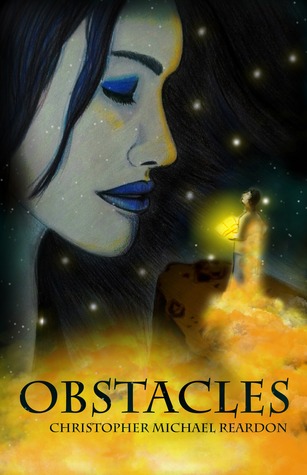
Obstacles by Chris Reardon

SUMMARY (from Goodreads): A child will die. You're afraid to live. Would you go to all lengths to save him? Darkness knows no bounds, as Alcott, an African American doctor sees all too well. The man is petrified by death. His fragile existence rests at the mercy of the universe. This fact is far too much for him to handle. From unyielding nightmares to elevator terrors, he's lost in paranoia.

Assigned to look after an ill child, Alcott's horrors only heighten. Gari is a nine-year-old boy with a fatal disease. He will surely pass on within the year. Alcott bonds with him more and more each day. Part of him knows this grim fate just isn't right.

Alcott befriends a hospital patient. This lunatic forces him to lug home an ancient text on bringing back the dead. Despite the man's obvious dementia, Alcott attempts the scheme. Charging up a cliff, he recites the chant over ocean gusts.

A god woman glides in from the horizon. She instructs Alcott on the trials to save Gari's life. These fearsome Obstacles require true strength. From battling sharks to wielding a flail, he must prove fortitude against genuine danger. Alcott decides his fate at this moment.
Death's claws shall not grasp Gari's soul.

MY OPINION:

Obstacles is Chris Reardon’s first novel, so I was willing to give it some leeway. However, there is only so much leeway I can give.

What I liked:

  • the premise of undertaking a Herculean-like quest in order to change fate and save someone from dying,
  • the lesson conveyed towards the end of the book, stressing the importance believing in oneself in order to succeed.

However, these were unfortunately overshadowed by what I didn’t like:

  • poorly developed characters:

    We don’t learn much about any of the characters. To start with, we never even learn what Gari’s illness is, or how Gari and Antuna can afford a live-in doctor, and what exactly Alcott does to help Gari.

    And is Alcott a first or a last name? We learn nothing about Alcott, besides the fact that he is a 30-something doctor (what kind of doctor?), though he acts and speaks like a teenager.

    Since I didn’t really get to know any of the characters, I didn’t care what happens to them and whether they succeed or fail.
  • in contrast with the lack of information about the characters, there is too much unnecessary repetition of easily-grasped data and concepts (I don’t need to be told the same thing five times, I’m not that stupid.)
  • the so-called obstacles, the tasks Alcott faces, are clichéd (sharks, labyrinth…) and there are just too many mythical elements from across cultures and genres (including humanoid aliens from Neptune) crammed together, all superficial and often rather silly.
  • poor vocabulary choices: it seems as if the author was trying too hard with the language, wanting to sound sophisticated, but it has the opposite effect – it sounds overdone, especially because of a modern setting and the first person POV narrative. Nobody thinks “we need to ‘dash’ out” and “i was ‘fatigued’“, do they?
  • the above said is in direct contrast with numerous grammatical errors, bad punctuation (so many ellipses), awkward or nonsensical phrasing (e.g. “I spark out” in the meaning “I say”), and colloquial language.
  • the scene structure is often illogical; for example, a person stands by the window and then goes to the window (without going away first), or a character faints again when that character hasn’t fainted yet in that scene.
  • And I could go on.

Overall, Obstacles suffers from insufficient revision and editing on all levels from content editing to proofreading. The teacher and the linguist in me were just itching the entire time to take a red pen and start jotting down corrections and suggestions for improvement. However, my time is too valuable to do that for free. Unfortunately, the editor, who is credited in the book and probably was paid, did a poor job.

Thus, Obstacles is basically a first draft with an interesting concept and possibly a potential of becoming a good, if not a great, book, but would need a few more rounds of revising and editing.

RECOMMENDATION: Clearly, I cannot recommend Obstacles, but if you have some time to spare and a will to try it, go ahead and form your own opinion.

1,5 stars

Disclaimer: I received a copy of Obstacles in exchange for an honest and unbiased review.

Saturday, May 11, 2013

Safe Haven (2013)


Safe HavenDIRECTOR: Lasse Hallström; CAST: Julianne Hough, David Lyons, Josh Dushamel…

SUMMARY (from IMDB): A young woman with a mysterious past lands in Southport, North Carolina where her bond with a widower forces her to confront the dark secret that haunts her.

MY OPINION:

I picked up Safe Haven a few years ago and although I had liked a few of Nicholas Sparks’ books, for example, Message in a Bottle, The Notebook, The Rescue, I couldn’t get past the first twenty pages or so of Safe Haven. I haven’t picked up a Sparks’ book since. Therefore, I wasn’t particularly interested in the film based on it. Basically, the only reason I watched Safe Haven was David Lyons.

My biggest problem with Safe Haven was that it didn’t make me invested into the main protagonists’ storyline. There are films (and books) when starting in medias res works great. Safe Haven is not one of them. Katie’s backstory is only shown in vague few seconds-long flashbacks and we learn what actually happened only about three quarters into the film, which made me feel disconnected from Katie. I just couldn’t care about her or root for her. For all we can glimpse in the flashbacks – some struggling and her scared face and bloody hands, she could have just as well been a murderess (albeit accidental) and/or a cheater. I think if the film started with showing her being abused, I would immediately sympathise with her and be more interested in her story.

Next, Katie’s romance with Alex follows the same path. We are not shown how they fall in love – there’s some misunderstanding, some flirting, and suddenly they sleep together, and only later – again three quarters in the film – Alex learns about Katie’s past and in the end they suddenly love each other.

Alex’s backstory would be interesting had it been presented less superficially. However, we are more or less only told rather than shown that he is struggling with the loss of his wife (I mean, he doesn’t hesitate at making his moves on Katie, so…). The same goes for how his kids deal with it. I think the whole matter was best portrayed by Alex’s little son. That says it all.

As I have said, the reason I even watched Safe Haven was David Lyons, who plays Katie’s abusive alcoholic husband. I am seriously partial to David Lyons, but still, his character is in my opinion the best developed and portrayed in the film. I know we are supposed to hate him, but I couldn’t quite.

Yes, mentally and physically abusing one’s spouse is a horrible thing and ‘but he/she loved her/him’ is never an acceptable excuse. However, I couldn’t but feel for Kevin, because he did love her and he was torn between knowing what he was doing was horrible and being sorry about it and on the other hand being unable to stop doing that. So, I couldn’t just simply hate him but I was wondering what has gone wrong. Kevin’s abuse and alcoholism were obviously old problems and it made me question what caused them and if anyone tried to do something about it and help him or not and if not, why? Did Katie try to talk to him and maybe get them into therapy, before things escalated? What about his job? Maybe something (or just regular stress) work-related triggered his alcoholism and abusiveness? How come his superiors didn’t notice anything earlier and made him get some counselling? You see what I’m getting at? Kevin is such a complex villain and so well-presented by David Lyons I can’t just simply hate him. If they meant me to do that, they should have opened the film with him cold-heartedly abusing Katie. I think that would have made an entirely different movie.

Another thing that bothered me in Safe Haven was the inclusion of ‘mystery’. Yes, in quotation marks. I started being suspicious about it after Katie’s dream and I wasn’t surprised at the revelation. What bothered me was how this topic was just put there as something on the side, because I usually like those kind of mysteries when they are properly dealt with. Thus, it just seemed like a cheap trick (and perhaps copying, I’m not sure which book was written first, Safe Haven or P.S. I Love You, but the latter was what this whole matter immediately reminded me of, except that it was far from being anywhere near to being as good).

Overall, I think Safe Haven’s main issue is trying to deal with too many topics, and while domestic abuse, loss of a spouse and a parent and dealing with it and letting a new person into one’s life, and afterlife are intriguing topics more than worth delving into, Safe Haven just  brushes past them and thus trivializes them.

Some films and books can make dealing with numerous themes work out great. Safe Haven is not one of those. A part of the problem is that Hallström (and Sparks) seemed unable to decide between making this a drama or a romance, and so they made a tasteless mix of both. Instead of exploring the themes and making the viewers think about them, Safe Haven makes the viewers do all the work and speculate about practically everything.  

 RECOMMENDATION: I can’t really recommend Safe Haven. Unless you are just looking for something to kill time with or for certain actor/actress. The main romance just didn’t interest me. I would have stopped watching after the first fifteen or twenty minutes if it wasn’t for David Lyons.


Wednesday, November 14, 2012

Deep Kiss of Winter by Kresley Cole (Immortals After Dark #8) and Gena Showalter (Alien Huntress #5)


Note: This review and the book reviewed reviewed contain adult themes. Please, do not read either unless you are an adult.

SUMMARY (from Goodreads): Deep Kiss of Winter contains two short novels: "Untouchable" (IAD #8) by Kresley Cole and "Tempt me Eternally" by Gena Showalter.

KRESLEY COLE delivers a breath-taking tale of a brutal vampire soldier about to know love for the first time ... and a Valkyrie aching for his touch. Murdoch Wroth will stop at nothing to claim Daniela – the delicate Valkyrie who makes his heart beat for the first time in three hundred years. Yet the exquisite Danii is part ice fey, and her freezing skin can’t be touched by anyone but her own kind without inflicting pain beyond measure. Can they conquer an agony of frustration and slake the overwhelming desire burning between them?

GENA SHOWALTER puts a daring spin on a tale of huntress and hunted ... and concocts a sensual chemistry that is positively explosive.
With only skin-to-skin contact, Aleaha Love can change her appearance, assume any identity. Now she’s an AIR (alien investigation and removal) agent on a mission to capture a group of otherworldly warriors. Only she is held captive when dangerously seductive Breean, a golden-skinned, iron-willed commander, threatens her new life – and for the first time, Aleaha wants only to be herself.

MY OPINION:

"Untouchable" by Kresley Cole

I knew Murdoch and Daniela would be awesome, and I was right. Their story runs parallel to the stories of the other three Wroth brothers –  so, from the beginning of the series – but with just the right amount of repetition. Hence, I was reminded of all the important things that had already happened, and I loved meeting all the familiar and beloved characters from the previous books again.

I felt so much sympathy for Murdoch and Daniela. They are both strong, but lonely, craving companionship and love but neither of them wants to impose on the other. They do not want to show their vulnerably by admitting how much they really care for each other. So, it takes them a while to work through it, especially since the chances of them being together seem very slim.

Daniela is partly ice-fey, and she hurts every time she is touched by someone not of her own race, which makes it impossible for her to form any kind of a love relationship. She pretends not to care, but she hurts on the inside.

Murdoch has problems accepting that his human preconceptions can no longer apply to his current situation. Also, he hates the concept of fate forcing him into something, so he fights the feelings he begins to develop towards Daniela.

Due to these issues they have a hard time coming together. However, they talk (and  argue, which was hilarious at times) about their problems, and they eventually work things out. I loved how, despite their disagreements and issues, they try not to hurt each other, at least not intentionally. They are really considerate and caring towards each other from the beginning, which makes up a sweet and warm relationship.

Overall, "Untouchable" is a touching and suspenseful story with some humour and Valkyrie snark (loved that, as always). The resolution for Daniela's and Murdoch's romance was so simple and brilliant I couldn't have seen it coming, On the whole, their love story was just prefect. Add the rest of the Wroth brothers and their wives. What more could you possibly want?

5 stars

"Tempt Me Eternally" by Gena Showalter

This is a really short novel, just over 200 pages. I only read it because it came included with Kresley Cole's novel. I was curious about it, since Gena Showalter is such a  praised paranormal romance author, but I did not like it.

A partial reason why I did not like this novella was probably because it is a part of a series, and I had not read the previous books. Therefore I was missing some background information about the world it is set in. But, this was my problem.

However, even bigger reason for not liking this book was the way the relationship between Aleaha and Breean is portrayed. It is basically all based on lust and sex, which I don't like, anyway. In addition, the sex scenes did not work for me, I had read much, much better ones. I could not feel any chemistry between Aleaha and Breean. They kept telling how much they want each other and love each other, but there was nothing in the story to support that.

All in all, the futuristic world Showalter creates seems interesting, but the romance and erotica in this novel were not my kind of thing.

2 stars

RECOMMENDATION: Deep Kiss of Winter is definitely worth trying for Kresley Cole's "Untouchable". Fans of Immortals After Dark series absolutely cannot miss on Murdoch's and Daniela's story. 

Wednesday, September 12, 2012

A Trick of the Dark by B. R. Collins


SUMMARY
(the blurb, find the book on Goodreads): Zach and his sister Annis have been uprooted from their home in London to live in a half-built barn in France. It is a desperate attempt by their parents to salvage not only their marriage, but a family as well.

When Zach chooses to defy his parents' wishes and visit a nearby ruined building, things really take a turn for the worse. A terrible accident leaves him crushed and broken beneath a collapsed wall. Annis can't believe that he could still be alive – but then Zach moves.

How on earth could Zach have survived such a terrible accident? And who is the sinister boy who appears out of nowhere? The boy who starts shadowing Zach, drawing ever nearer, ever closer…

MY OPINION:

When Zach survives an accident that should have killed him, strange, sinister things start happening around him. As it is common for YA novels, the only person he can count on is his younger sister Annis, as their parents are clueless, too absorbed in their marital problems, and unwilling to actually listen to Zach and Annis.

So far so good. The main issue of the book, namely what happened/is happening to Zach, revolves around an unique and intriguing idea concerning avoiding death and the price that comes with it. However, I think it would be better explored through the eyes of more mature characters. It seemed to me as if Collins could not decide whether to focus on Zach's and Annis' teenage angst or on the mortality issue.

Zach and Annis are typical teenagers: they defy their parents, they behave stupidly and sometimes selfishly, and they quarrel for silly reasons. Of course, they love and help each other and cover for one another. I do not want to say too much about them lest I spoil the book for you. Let me just say, they have their problems, Annis' poor self-esteem being one of the most important ones. Additionally, there are some things about them I would like to know which Collins does not provide. Due to the holes in characters' presentation, I did not really care about what happens to Zach and Annis.

The thing that annoyed me very much was the discrepancy between their behaviour and age. Only one third into the book we learn Zach and Annis are 17 and 15, respectively. But, they talk and think like children aged perhaps 12 – 15, and they parents boss them around like that, too. However, in contrast to this, they allow them to drink coffee and wine (!), and expect them to be responsible like adults. This combination of behaviour/treatment is very confusing, and it ruins the exploration of an otherwise interesting topic.

Overall, A Trick of the Dark is based upon a fascinating idea. Unfortunately, it is not thoroughly explored.

RECOMMENDATION: A Trick of the Dark has some intriguing elements. It could be an interesting read if you like YA characters and if you don't mind the fact that both the topic and the characters are dealt with somewhat superficially.

Wednesday, August 29, 2012

Awakened by a Kiss by Lila DiPasqua


Note: The book reviewed is not suitable for persons under the age of majority.

SUMMARY (from Goodreads): Three classic fairytales – “Sleeping Beauty,” “Puss in Boots,” and “Little Red Riding Hood” – cleverly retold with enough sensual twists to prove wickedly ever after does exist….

Sleeping Beau: Five years ago, the notorious rake, Adrien d’Aspe, Marquis de Beaulain, was awakened by a sensuous kiss – and experienced a night of raw ecstasy that was branded into his memory. Years later, he spots his mysterious seductress – and this time, he has no intention of letting her go…

Little Red Writing: Nicolas de Savignac, Comte de Lambelle, has been assigned by the King to uncover the secret identity of the author writing scandalous stories about powerful courtiers. He never expected his investigation would lead to his grandmother's house, or to a ravishing woman who would stir his deepest hunger…

Bewitching in Boots: Elisabeth de Roussel, daughter of the King, is accustomed to getting what she wants – and she wants Tristan de Tiersonnier, Comte de Saint-Marcel, an ex-commander of the King’s private Guard. A recent injury has forced Tristan to leave his distinguished position, but Elisabeth is determined to make him see he's every bit the man he once was – and more than man enough for her..

MY OPINION:

Awakened by a Kiss is a collection of three novellas loosely based on classic fairy-tales. The stories are set in France during the reign of Louis XIV and faintly depict the glamour and the intrigues of his court.

The connection of the stories to the corresponding fairy-tales is VERY loose. The main characters and an echo of the fairy-tale plot can be recognised, but no more than that. All three novellas are focused on sex, therefore the plot and characterization are all but non-existent and serve only as a background.

The plots and characters' depictions are rushed in order to make place for erotic scenes. Now, I enjoy erotica when it comes in package with a compelling plot, possibly some suspense, and well-developed characters, which is not the case in these stories. The stories in Awakened by a Kiss have interesting premises, but their potential remains largely unrealised.

Of the three stories, the third one, Bewitching in Boots, is the one I enjoyed the most. Even though everything said above holds true for this one, too, I liked that Elisabeth actually helped Tristan go through some difficulties.

Finally, I think these three novellas would be much better if expanded into full-length novels, thus allowing for plot and character development. Anyway, Awakened by a Kiss is an easy read for when you just want your brain to rest for a while.

RECOMMENDATION: Awakened by a Kiss is readable if you want just a light adult read. However, if you are looking for erotica with a memorable story and the characters you fall in love with, this is not it.

Wednesday, April 11, 2012

Evermore (The Immortals #1) by Alyson Noël


SUMMARY (from Goodreads): Since a horrible accident claimed the lives of her family, sixteen-year-old Ever can see auras, hear people’s thoughts, and know a person’s life story by touch. Going out of her way to shield herself from human contact to suppress her abilities has branded her as a freak at her new high school – but everything changes when she meets Damen Auguste...

Ever sees Damen and feels an instant recognition. He is gorgeous, exotic and wealthy, and he holds many secrets. Damen is able to make things appear and disappear, he always seems to know what she’s thinking – and he’s the only one who can silence the noise and the random energy in her head.  She doesn’t know who he really is – or what he is. Damen equal parts light and darkness, and he belongs to an enchanted new world where no one ever dies.

MY OPINION:

Evermore has a good premise, but it does not develop it to its full potential. 

There are a number of things that bother me:
  • Names: Ever (really, Ever?), Damen (no, it is not similar to Damon at all, nope), Drina (a little research shows it has nothing to do with Italian poverina, instead it is a version of Adriana, and Drina is also a river in Bosnia).
  • Just like his name, Damen’s Latin appearance, behaviour, and wearing black do not ring a bell for any other character. Or do they? Oh, wait. The author may want Damen to resemble Damon but is light-years away from him.
  • Ever taking forever to figure out Damen is not mortal and to reveal why she feels responsible for her family’s accident. (This is not a spoiler, it is pretty much clear both from the blurb and from the first page onwards).
  • Teenage boyfriend drama. No explanation needed here.

I think this book would be so much better if it was not YA, if Ever’s character was older, perhaps in her twenties, if she was someone who could think more clearly and reflect on the important issues the book opens but does not fully develop, the most important being mythology.

Evermore is a fast read. The ending is conclusive, so the book can be read as a stand-alone. I do not think I will continue reading this series since I am not invested enough in the characters to really want to know what happens to them. Although, I might pick up another book in the series when I just want to read something fast and light.

RECOMMENDATION: This is an undemanding YA read with quite a few shortcomings, perhaps best read when you want to kill some time and give your brain a vacation.

Wednesday, March 07, 2012

The Last Werewolf by Glen Duncan


SUMMARY (from Goodreads): Jake Marlowe, the last werewolf, is alone now. Sick to his bones of the unending toil of existence and bored beyond endurance by the monthly cycle of carnage and self-disgust. On the run torn between refusal to cede victory to the Hunters and simple yearning for it all to be over he is also on the verge of surrender. Then he catches the trace of an impossible, an inconceivable scent. Not just the scent of another Wolf: the scent of a female. Suddenly, the world contains the possibility of love. Which means that now, for Marlowe, the chore of existence is both infinitely sweet and unimaginably dangerous.

MY OPINION:

I had heard much praise of The Last Werewolf prior to reading it, so I had had quite high expectations, which the book did not live up to. 

Jacob, the last living werewolf, is a resigned man with a nihilistic view of the world. He does not believe in goodness. He does not see a purpose in life and the only value he cynically emphasises is the value of money. He has one redeeming quality – he uses his wealth to occasionally help people in need, and he does not want to give any credit to himself for doing that.

Tallula is similarly dislikeable, mostly because her character and her relationship with Jacob are both dealt with quite superficially. Despite giving the readers some back-story, Tallula mostly strikes me as a fairly unemotional person. Perhaps this is due to a very inadequate description of her coming to terms with her identity as well as coping with the situation she is dragged in when meeting Jacob. I would expect her to have a lot of questions, to struggle through new information, but she simply accepts things and moves along.

All things considered, I was unable to connect with the characters. For the most part of the story I did not even care what happens to them.

I was bothered by some other things, too. Jacob objectifies women, sex is meaningless, and vulgar language is used for its own sake alone. Additionally, there are also a few rather confusing parts where it is unclear which character is speaking or thinking.

The one thing that I was very curious about was what kind of theory of the origin of werewolves Duncan would set. However, the author only keeps teasing the reader with the promise of revealing this theory and in the end does not deliver it. Huge disappointment.

Finally, I have to give credit to The Last Werewolf for being bold and different from other books in the genre. For those very features, some people might like it, although it was not my cup of tea. 

RECOMMENDATION: This book is full of violence and gore; therefore, it is not for those with weak stomach.

Monday, November 28, 2011

The Good Man Jesus and the Scoundrel Christ by Philip Pullman


The Good Man Jesus and the Scoundrel ChristSUMMARY: (from Goodreads): Part novel, part history, part fairytale, The Good Man Jesus and the Scoundrel Christ offers a radical new take on the myths and the mysteries of the Gospels, and the genesis of church that has so shaped the course of the last two millennia. With all the magic for which Pullman's storytelling is famed, this provocative and thoughtful new book from one of Britain's best loved writers promises to be the highest profile yet in Canongate's acclaimed Myths Series.

MY OPINION:

This book is an example of a unique approach to presenting the author’s view on Christianity and the Catholic Church. Philip Pullman, a self-proclaimed atheist, presents his view on the ideas of Christianity - the good side, illustrated in the character of Jesus, whereas the character of Christ represents the Catholic Church - clearly presenting the bad side.

As a Christian, I find it difficult to say anything specific about this book without explaining my religious beliefs. However, a book review is not a place for such a thing. Therefore, I will just say that The Good Man Jesus and the Scoundrel Christ deserves recognition for its originality and the author's knowledge on the subject. Hence, I rate it **A LITTLE STRANGE due to its language and creativity. The content is on my opinion impossible to rate, since the book deals with a complex issue resolvable only by everyone on their own, or not even that.

This book is a highly provocative and thought-provoking read. It asks a lot of questions and tests the readers’ beliefs. It is the kind of book that demands an open mind and must be taken with (more than) a grain of salt. 

RECOMMENDATION: This is a not a book for people who are easily offended or not ready to put their beliefs to a test.

Wednesday, October 05, 2011

The Alarming History of European Royalty by Karl Shaw

Royal Babylon: Alarming History of European RoyaltySUMMARY (from Goodreads): An uproarious, eye-opening history of Europe's notorious royal houses that leaves no throne unturned and will make you glad you live in a democracy.

Do you want to know which queen has the unique distinction of being the only known royal kleptomaniac? Or which empress kept her dirty underwear under lock and key? Or which czar, upon discovering his wife's infidelity, had her lover decapitated and the head, pickled in a jar, placed at her bedside?

The Alarming History of European Royalty is history, but not as they teach it in school, and it underlines in side-splitting fashion Queen Victoria's famous warning that it is unwise to look too deeply into the royal houses of Europe.

MY OPINION:

The Alarming History of European Royalty deals with its subject in a sensationalistic manner. It mainly focuses on history of mental illnesses and sexual exploits of European royals, scandalising their behaviour.

The book is written in a tabloid-like style, which I disliked. Not only it focuses on bad things, it is at times also disrespectful, for example, when making fun of King George VI and his stammering problems.

Moreover, there are many inconsistencies or confusing information in the book, showing the lack of research behind them. The factual errors, such as stating the years of birth and death incorrectly, are also disturbing. One of such errors that strikes out is the one saying that Prince Albert died three years before he was born. These kinds of things are not just ridiculous but also unprofessional. The book obviously lacks some editing and revision. I must stress I read the book in translation, therefore some errors might have occurred during the translation process, but I find it hard to ascribe the majority of mishaps to the translator.

However, all the shortcomings put aside, I still could not put the book down, mainly because the information on all the connections between European royal families is intriguing.

Finally, The Alarming History of European Royalty provides some interesting data, but it should be taken with a grain of salt. The truth, I believe is always somewhere between scandalizing and sanctifying people.

RECOMMENDATION: This book is not to be taken as a serious read about history – if you want that, pick up a different book. But if you want to learn about all the true (or perhaps not so true) scandals of European courts and are willing to give some slack to the writing and inaccuracy, The Alarming History of European Royalty might be an interesting read. 

Wednesday, August 24, 2011

The Catcher in the Rye by J. D. Salinger

The Catcher in the RyeSUMMARY: A seventeen-year-old Holden Caulfield tells a story about what he did during a few days a year ago when he was expelled from school. Instead of going home, he aimlessly wanders the streets of New York, making observations about everything and everyone and behaving stupidly.

MY OPINION:

I first read this book when I was around 18. Rereading it now, it was quite a different experience, because my English is now much better than then and because now I can see it from a teacher’s perspective.

Nevertheless, I could not find many things to enjoy in this book. The plot itself was disappointing. I kept waiting for something big to happen, but there is no such event, just a teenager rambling about.

Holden is a spoiled rich boy, who is constantly complaining about everyone being phony. He is intelligent but lazy which is why he fails most of his classes and gets kicked out of school. He behaves foolishly and spends his money carelessly. The only sympathetic characteristic I could find about him was his affection for his dead brother. Otherwise, he is just an annoying teenager, alienated from his parents, though they seem quite ordinary parents for their class and time, at least Holden does not provide any solid example of them not being nice to him.

What I like in The Cather in the Rye is how Salinger captures teenage slang in such a timeless manner that can be related to teenagers in the present. Also, the following of Holden’s statements made me laugh (it was sarcastic bitter-sweet teacher's laughter): “You can’t stop a teacher when they want to do something. They just do it.” and “You don’t have to think too hard when you talk to a teacher.”

There are a few such sarcasm-provoking sentences scattered across the book, which livens it up a little. I found the parts where Holden expresses his opinion on a few books and films interesting, too, since I obviously like talking about these topics.

RECOMMENDATION: Need a substitute for an afternoon nap? Read this, it is very calming and relaxing, nothing too exciting; that is if you do not get unnerved by teenage rambling. 
  

Monday, April 04, 2011

Playing Easy to Get by Sherrilyn Kenyon, Jaid Black and Kresley Cole


Note: This is a review of an adult book. Please, do not read either the review or the book reviewed unless you are an adult.

Playing Easy to GetSUMMARY (from the publisher): New York Times bestselling author Sherrilyn Kenyon and rising stars Jaid Black and Kresley Cole unlock the pleasures and perils of embracing the boldest and most powerful of lovers – 100%  alpha males – in three sensually erotic tales. Discover the physical rapture of his muscular arms... Become a prisoner of passion, swept away by an encounter with his primal side... And get lost in the all-consuming thrill of white-hot pursuit by a relentless stranger who may be your most dangerous foe, the best lover you've ever had – or both.

MY OPINION:

Playing Easy to Get is a collection of shorts stories by different authors. I will review each of the three on their own, because all they have in common is genre, which is erotic (paranormal) romance.

Turn Up the Heat by Sherrilyn Kenyon

Allison is an average American woman. She is a cleaning lady in a Wal-Mart in a small town. She finds escape in reading a romance novel called Sugar and Spice. There is a contest the winner of which can live for a week as the heroine of the book on an island surrounded only by handsome men who do everything the heroine wants.

Allison is too shy to dare to apply, but then her high school friend Maggie appears in the town and convinces her to enter the contest. Maggie works for Wulfgar Zimmerman, Z in short,  a very rich and successful businessman who finances the whole thing, and she pulls the strings so that Allison wins.

Vince is Z’s childhood friend, a gangster, who wants to go legit, but his boss sends killers after him because he knows too much. Z hides him among the men on the Sugar and Spice contest experience. Naturally, Allison and Vince meet, like each other and consequently subside to their lust, being interrupted by mafia hit men.

So much about the plot, nothing unexpected. except that the contest, Maggie, Z and all the chain of events seem far-fetched. If I understand it correctly this short story is supposed to be about what is possible to happen in real life, but ends far from such. SPOILER: I don’t think FBI is as lenient to wannabe-ex-gangsters as it is to Vince, including him and Allison in a top secret specialist team in the end. END OF SPOILER.

Next, Allison does not appeal to me. In the beginning she hates her job, feels sorry for herself and drowns her misery in fantasizing about the hero from her favourite romance instead maybe taking some classes and trying to change her fortune. Then all of a sudden she turns into an adventurer and becomes a tough girl who fights with gangsters, showing no fear. Although development of characters is desirable, Allison’s lacks the transition from one kind of a person to another.

One thing I liked about this short story was Kenyon’s writing, especially her sarcastic attempts to mock the romance genre. She uses some witty phrases, such as “lust at first sight" and, Allison wishes a house would land on top of her floor manager and put “him out of her misery."  Therefore, I rate this short story ** A LITTLE STRANGE.

Hunter’s Oath by Jaid Black

After her brother dies in a helicopter crash, Sophia travels to his funeral in the Arctic Circle. On the way from the funeral she is kidnapped to be sold on an auction for a bride to a member of an underground Viking civilization. Before the auction, an old lady healer mixes an aphrodisiac in her tea, so Sophia becomes a sexual maniac and is therefore able to fall in love with her “husband”/master and they live happily ever after.

I can’t even begin to tell how absurd and repulsive I find this plot. Firstly, there is no way a sane woman would fall in love with someone she is forcefully wed to. Surely, she might as a part of one’s mind’s survival strategy, or the Stockholm syndrome, but it would not have been real love. Secondly, I do not see how on earth would a modern, successful, emancipated woman, being used to all the comforts of the contemporary world adapt to a life in a primitive society in a blink of an eye. Finally, I found the whole sex issue in this short story just disgusting. I am not a prude or I would not have ventured to read this genre, but I prefer sex to do at least something with love.

The idea of the ancient Vikings surviving in secrecy in an underground world up to these days is, I must admit, interesting. Perhaps the author should concentrate on that and develop it, and work harder on the conflict which would arise if a person from a modern world encountered the society that is thought to have been long gone, which could potentially result in a decent novel. However, this short story, such as it is, is on my opinion only ** A LITTLE STRANGE just because of the Vikings idea.

The Warlord Wants Forever by Kresley Cole

This short story is the reason why I bought the book in the first place. It is the first part of Immortals After Dark series. I read the first novel in the series, A Hunger Like No Other, before this short story, and although it was perfectly readable and understandable on its own, it intrigued me so much that I wanted to find out how everything starts.

The Warlord Wants Forever has nothing in common with the other two short stories in the collection, apart from the genre. It is the longest short story in the collection – it could easily become a novel with a few more pages. It is also by far the best of the three. This is why I decided to review it in a separate post. I rate it **** VERY STRANGE.

RECOMMENDATION: There is nothing to miss if you just skip the first two short stories and move right onto the third which is an original and compelling approach to paranormal romance. 

Wednesday, March 23, 2011

Cambridge Wizard Student Guide: The Curious Incident of the Dog in the Night-Time by Richard McRoberts

Cambridge Wizard Student Guide The Curious Incident of the Dog in the Night Time (Cambridge Wizard English Student Guides)SUMMARY: The Guide contains chapter summaries and character analysis with quotes, information about autism, sample essay questions and sample essays.

MY OPINION:

My review is based on the helpfulness of this student guide to ESL high schools students.

I think this book is somewhat useful to ESL students with advanced knowledge of English and above average grades. Those students might use the guide as a quick reference book to refresh their memory. The same goes for teachers in this case. Essay samples might be helpful to those same students in terms of showing them the level of writing they should aim to achieve.

Apart from the above, the guide has little use. The summaries are too general to be of any real help and character portrayals and other analysis too demanding for students struggling with mediocre and low grades.

RECOMMENDATION: I am somewhat disappointed by this book. Its main value is in serving as a reference book, but both teachers and students would have to use other resources when approaching Mark Haddon’s The Curious Incident of the Dog in the Night-Time.

Thursday, January 06, 2011

Dark Mysteries of the Vatican by H. Paul Jeffers

Dark Mysteries of the VaticanSUMMARY: The Catholic Church is the oldest and the most influential institution in the world. Its secretiveness has always been accompanied by lies, scandals and conspiracies. Dark mysteries of the Vatican include everything from the plot against the Templar Knights to sympathising with the Nazis, from exorcism to the Church’s view upon aliens and the end of the world.

MY OPINION:

At the beginning I have to say that this book was not what I had expected it to be. I had supposed it would either be gravely discrediting the Vatican or ardently defending it. However, Jeffers does neither of these.

Dark Mysteries of the Vatican is predominantly a factual book. It provides a lot of evidence acquired through a thorough research. Jeffers is a very objective author. Whichever myth, secret or rumour he focuses on, he tries to resolve it by stating factual proofs from various documents, including the vast quantity of material from the Vatican archives.

The most interesting parts of the book to me were those about the book prohibition process and murders and the history of the Catholic Church, from which I actually learned something new. Generally there was only few data surprising or new to me, but it might be just because I have been always interested in the Church and I knew a lot about it prior to reading this book.

Also, I felt at times the book is even a little over packed with data and in other places lacking information. The latter is understandable due to a very limited access to some Vatican documents. What has always been most intriguing for me and is still left unsolved is the question why the Church is so reluctant to make public the documents which could clarify some confusing issues or in particular cases possibly clear its name, unless those documents would be unfavourable to the Church, or it might be somehow for our own benefit.

All in all, Jeffers’s objective, fact-based approach is praiseworthy, although it has one flaw as I see it, which is that it hardly provides any conclusive answers. Nevertheless, it is not necessarily a bad thing, since everyone can come to their own conclusions according to their beliefs and in this way the book avoids offensiveness, which is very important dealing with such a delicate subject matter.

RECOMMENDATION: If you are interested in all the mysteries about the Vatican and the Catholic Church and you are not too squeamish about scandalous insinuations, this is definitely the book to read, but do not expect to get any final answers. Instead, you will get a lot of factual evidence upon which you can form your own opinion.

Thursday, November 04, 2010

La Cucina by Lily Prior

book cover of 

La Cucina 

A Novel of Rapture 

by

Lily PriorSUMMARY (by Fantastic fiction): La Cucina combines the sensuous pleasures of love and food, simmering in the heat of a Sicilian kitchen. Rosa Fiore is a solitary woman who has resigned herself to a loveless life, and expresses her passionate nature through her delicious cooking. Then, one day, she meets an enigmatic chef, known only as l'Inglese, whose research on the heritage of Sicilian cuisine leads him into Rosa's library and into her heart. They share one sublime summer of discovery, during which l'Inglese awakens the power of Rosa's sexuality, and together they reach new heights of culinary passion. When he vanishes unexpectedly, Rosa returns to her family's estate to grieve for her lost love only to find a new fulfilment, as well as many surprises, in the magic of her beloved cucina.

MY OPINION:

I rushed through this book as if I was running through the hail storm looking for safety. What a relief when it was over! This is one book I really did not like.

The promising title and summary are, as far as I am concerned, not justified by this book. I was bored reading it from the beginning to the end. The writer wants to tell a simple woman’s life and love story, but fails to create suspense. In an attempt to make the story more interesting, Prior introduces some elements of grotesque which eventually turn out just disgusting. I usually do not mind grotesque or disgusting, but in La Cucina it just comes out inappropriate and (still!) boring.

La cucina (the kitchen) is hardly worth mentioning. Prior does not succeed to present the Sicilian cuisine in an appealing way. In addition, in Prior’s book the kitchen as a place represents an unhealthy substitute for love. When Rosa is sad, lonely or scared, she finds escape in her kitchen, cooking and eating. It reminded me of modern anorexic and bulimic girls all the time.

Yet, there is one good thing about this book:  the style. Prior writes in a way a middle-aged, simple, rural, Italian woman would be telling the story by herself. Through the language I could imagine Rosa, her thinking and her feelings. That was the only reason I kept reading the book through the end.

RECOMMENDATION: Maybe it is just me who does not like this book, so if you generally are an easy cuisine-and-romance type of a reader, you might give it a try.